BIO
Luke Berman is a vegan of six years and extremely passionate about wildlife, conservation and especially primates. He has worked for local authorities, social enterprises and charities like ‘The Conservation Volunteers’, where he developed skills in teaching people how to manage and look after the environment. He is now developing a career in Primatology and is off to Kenya in February for six months working with Colobus monkeys; before hoping to start an MSc in Primate Conservation at Oxford Brookes in Spetember 2014.
1) When and why did you decide to climb Mt. Kilimanjaro?
It all started in November 2012 when I wanted to do a big fund raising challenge for Wild Futures & to promote the benefits of a vegan diet. Wild Futures works to protect primates and habitats worldwide. It also has a Monkey Sanctuary where it gives ex-pet primates a home for life as they can never return to the wild. Unfortunately it is still legal to keep primates as pets in the UK and it is currently estimated there could be around 5,000 primates kept as pets. Due to the fact most primates live in large social groups and are not domesticated they suffer very badly, physically and mentally, as pets. At the Wild Futures Monkey Sanctuary some rescued monkeys have deformed bones, diabetes (caused from being given sweets) and carry out repetitive actions like rocking or head spinning.
I have been volunteering for Wild Futures since 2005 and spent a year living and working at the Monkey Sanctuary, in Cornwall, from 2010 and have been an ambassador since 2012. This charity is very close to my heart and it was a privilege to be able to undertake this challenge for them.
2) How long have you been a vegan and what made you go vegan?
Uhuru Peak 5895m 'The roof of Africa'
I actual went vegetarian when staying at the Monkey Sanctuary in 2007 for a month, then when I went home two weeks later I decided to go vegan. Six years on I still believe that was the best decision I have ever made.
Before going vegan I was a heavy meat and dairy eater and was a big stocky rugby player. As I was going through my university degree (Wildlife Conservation at Plymouth Uni) I was learning more and more about the environmental impact of a western diet, and the animal cruelty involved in producing meat and dairy. For example a vegan diet uses about a third less land than a standard western diet. Also, why should animals be cooped up in cramp, painful conditions and then be killed just so I can have a meal. I decided that I didn’t want to be a contributor to this anymore and wanted to make a positive difference. The fact it was also healthy was just a great bonus.
3) What preparation did you do for the climb?
Joey was in a cage alone for 9 years
As mentioned earlier I decided to do the climb in November 2012 and that left me ten months to prepare; as the climb was in September 13. I already had an alright level of fitness as I like to go the gym, do long walks and running, but I knew I would need to build endurance for this challenge. You are walking for eight days for up to ten hours, so it is a mental challenge as well as a physical one. I started going for long walks on the weekends to build up my leg strength. On top of this I was doing a lot of bodyweight training, which are exercises such as push-ups, sit-ups, pull-ups etc to build core strength. Within a month of the climb I started to go for eight hour walks and find as many hills as possible; the dog was very pleased.
In all honesty nothing could have prepared you for the summit climb. After climbing for six days we began the final walk to the top. Leaving at 11pm in -10 degrees and dropping to -20 we climbed 1400m in altitude and walked uphill for eight hours. After three to four hours you are relying on mental strength alone, water bottles have frozen, eyes are closing, and the top looks so very far away. Once at the top you can only stay for an hour due to the altitude and so must then climb down for three hours, have some lunch and then another three hours to the camp where you sleep. All in all it was seven days up and one and a half days down.
4) How did the rest of your group react to you being vegan?
Luke & the guides
There was not as much shock as I thought there was going to be. Our climb leader was a vegetarian and so was another woman, however, everyone else had a standard diet. I did get some early questions regarding how was I going to get enough energy from not eating meat and dairy, but I think the fact I was always at the front of the group and not as out of breath as the rest made them soon realise I was not going to have a problem. The best moment was when one member of the group turned round to me, about half way through the trip, and said ‘I have a whole new understanding and respect for vegans. Before I didn’t know much and thought it was unhealthy, but now I can see it is perfectly healthy.’
5) What did you eat during the trip, and was it easy to get vegan food?
We were above the clouds for 4 days
I took high protein & carbohydrate energy bars with me, as well as bags of peanuts and raisins to snack on during the walks. The cook we had with us was excellent and went out of his way to make sure food for me was prepared correctly and without animal products. Mornings consisted of porridge made with water, I added nuts and raisins with a cup of ginger tea (an excellent pick me up in the morning). Lunch and dinner mainly consisted of a carbohydrate (pasta/rice/potatoes) with a vegetable and bean sauce. There was also a meat one for the others. The food porters would always bring my food in separately small Tupperware boxes, which was such a nice gesture. The fruit at dinner time was really appreciated as the food got quite samey.
Are there any vegan Tanzanian delicacies?
There are a couple of Tanzanian breads using local flour and water which are quite tasty, but I am afraid most of their dishes contain meat. But they do love cooking with bananas, which were lovely to eat.
6) Have you got another adventure planned?
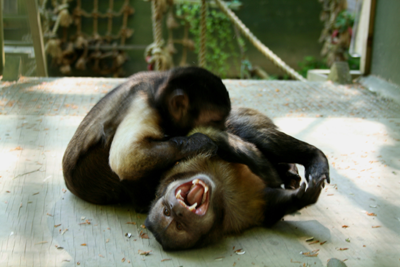
Joey & Charlie playing
I am looking at Tough Mudder, which is a twelve mile run through obstacles such as crawling under barb wire, running through fire and swimming through frozen water. I am definitely up for more challenges after this.
Also, donations are still being taken for my climb through justgiving – www.justgiving.com/luke-berman My contact details:
Email – lukeberman@hotmail.com Twitter - @lukeberman
I also coordinate activities in London for Wild Futures, please let me know if you want to get involved.
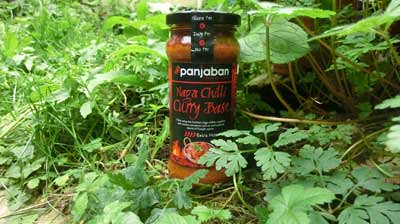
This is a mixed bag of stuff today. First off Curry! Panjaban curry
I found these curry sauces at the London Vegfest. The Naga was the hottest (I believe), but I also bought several milder versions to test out. I never normally like bought curry sauces as much as those made from scratch, but these were actually pretty good. They may not be perfect for some people on a very low calorie cutting phase, but at the moment I'm jumping up a weight class, so getting enough calories is my main issue. If you are on an average calorie intake these will be an good choice if you want to knock out a curry at speed. I tried four of the flavours & everyone I tried was pretty good (obviously it depends a couple are quite hot, so be aware of the hotness before buying). I'd give them a thumbs up :-).
You can find out more about these curries by clicking here
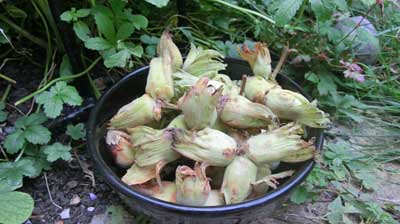
Cobnuts
I'm not sure if you can even get these in other countries, but in the UK, for a few weeks in Autumn, you can find the elusive cobnut. Cobnuts are a type of hazelnut. They are grown in Kent as far as I know & that may be the only place for all I know?
These do not taste like hazelnuts. They have a shell you can bite open (assuming your teeth are reasonable). My method is to peel off the outside leafy cover, crunch the shell open with my teeth & then tuck into fresh cobnut! As you only get a few weeks to enjoy them, it's a brief fab treat as you have 12 months before you can get them again.
Here we go a brief cobnut background (thanks Mr Google!!!) seems there are only about 700 acres of cobnuts in the whole of the UK! I'm guessing calorie-wise they are about the same as other hazelnuts?
I think they are a super cool nut, so I thought you'd be interested.
Now all we need is for someone to invent a cobnut curry :-)
See all the fun & frolics we had at the London Vegfest just click here to go straight to our write-up of the event. I hope you enjoy reading it & consider popping along to one of the shows we attend in the future.
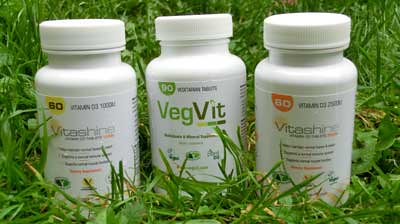
Recently I have been trying out the new vegvit & the new vitamin D3 tablets from vitashine. Before we look at each of these separately I would like to point out that neither vitamin D, nor a multi will give you a "I took this & gained 20 pounds" or "I took this & it made the me a beast when I worked out". A basic multi is kind of like an insurance, you should be eating everything you need to get all the nutrients, but just in case a multi will cover any you might inadvertently miss out. This is especially true for those who are dieting down as lower calories means less chances to get everything you need. The same is true with vitamin D, you may not be getting enough, but for different reasons we'll look at below, but first let's look at vegvit.
Vegvit
Vegvit is the new multi from the makers of vitashine & opti3 vitamin D3 & DHA/EPA pills. This is their first go at a multi so I was interested to see what they could come up with. My first look is quite encouraging, they have pretty much everything in it you'd want, they do not mega-dose (more is not always better) & they have a nice mix of less common things added as well (like superfood extracts etc). Also a lot of the minerals are in the form of chelates & so are absorbed more easily than other commonly used (cheaper) ingredients.
I did find a couple of interesting points that I have asked for clarification about. The first is that in the ingredients it says "Vitamin A (as beta-carotene & vit A conc)". I have not heard of a vegan vitamin A (Retinol) being available? This could be just a brand name for a proprietary carotenoid blend or similar, but I have asked about it. I liked the inclusion of the plant extracts, that is unusual in a multi pill & I thought it was a nice touch. The only thing you may consider 'missing' from this pill is the inclusion of a vitamin K2. There is vitamin K1. I know that the need has not been 100% proven, but I personally believe that it is a useful addition to the diet (either through supplements or through the inclusion of fermented foods). It would have been perfect if it had included that (I don't think there is a multi that includes it, so it is not exactly lacking in that department, it would have been nice though) - for more on K2 check out this blogpost.
So, I'd say the pill gets 99 out of 100 as it doesn't mega-dose & has a nice mixture of vitamins, mineral & natural plant extracts.
I'm guessing that many of you have tried out the 5,000IU vitashine capsules or the spray. They have now expanded the range to include a 1,000IU & 2,500IU solid tablet. Unlike a multi, you do not generally get vitamin D in plant foods (unless they are fortified).
The ideal is to get vitamin D from the sun, unfortunately, many of us work indoors & only have limited times of during the year when it is possible to synthesis vitamin D. I have seen studies that have shown that as many as 50% or more of the population of western societies may have sub-optimal vitamin D levels! How does that affect you? Well, if you are a strength athlete then vitamin D can also be classed as a hormone & levels have been shown to affect strength, so if you are chronically low, then your strength may be being held back by low levels. Also bone & teeth strength are linked to vitamin D, so adapting to a new load could be slowed if the bones are not adjusting to increased loads as quickly as they should (bones & ligaments are the slowest to adapt to changes, so they could possibly hold you back at times). There are dozens of ways that vitamin D may affect training from immune function to strength output (in some studies), so if you are serious about strength you will make sure your vitamin D is at an adequate level. Other factors you might like is that the tablets taste like sweets! They are very tasty, so I would rate them for that. If you have a sweet tooth, it could even help take off that edge? I'm not really a 'sweet' person in general, so I'm guessing, but I thought it was worth mentioning. The good thing is that you now have loads of options. You can go for the spray, the 1,000IU pill, the 2,500IU pill or the 5,000IU capsule, so you have a load of choices. Personally I will probably stick to the 5,000IU during the winter, so my levels stay high, but during the summer I may drop down to the 1,000IU or 2,500IU (depending on how the summer is going). A lot will depend on where you live, how much you can get outside & your skin colour when deciding which might be the best vitamin D for you. The darker your skin, the less time you spend in the sun & the further north (or south in the southern hemisphere) you are will mean the more you ought to consider taking. So, there isn't an easy answer about intake. If you have any concerns you can get tested for vitamin D as it is a fairly common test available now, for more on vitamin D take a look at this post on the subject. I rate vitamin D as pretty vital for anyone not getting out into the sun on a very regular basis (& for those in the far north or south even that does not increase levels), so I consider this a absolutely vital supplement for me!
Where to buy
You can get vegvit pills here
You can get vitashine vegan vitamin D3 here As a side note they do also make a DHA/EPA pill that you can get here
I will try my very best here not to make this sound like a personal attack, but I will be using one person as an example of the confusion that reins within the meat-eating community of bodybuilders concerning the fact that some people choose not to use meat & dairy. At the moment marketer Vince Delmonte has started an attack on bodybuilders who choose not to eat meat or dairy. I'll put the links below:
He has also done a blogpost here I suggest you view the above & the article as you'll need those to see what he is claiming. I think you'll find it interesting how people are affected by words & how they can be confused by meanings to draw totally incorrect conclusions from sometimes correct ideas.
At the very beginning of the video he says that he, as a trainer, cannot help people gain muscle, loss fat or improve health using a vegan (or even vegetarian) diet To paraphrase him he says "You are wasting your time & his time" by trying to achieve any of those goals. This statement is saying more about the trainer, than the actual possibility of training without meat or dairy. Let's look at these goals he cannot help if you eat plant-based:
1/ Health - wow! I do not know where to start with this one. The science is pretty clear that you have improved fat levels, improvement of multiple health-factors that positively effect health (if you want some references on general or specific health issues let me know in the comments), but think blood pressure, cardiovascular health, cancer risk....I could go on, but you get the idea, if you want a quick look at few of the benefits scroll through a few of these pages on the messageboard& check out some of the health benefits mentioned there.
2/ Losing fat. I do not know where Vince has been. I'm guessing that as he said he has not touched a trainee since 2002 unless they ate meat means he has also not seen the research since that time! Do I need links for this? Seriously if you want links to studies that show going vegan will help you loose bodyfat I have many, it can be done easily, infact a wholefood vegan diet is probably a very easy way to eat & lose bodyfat.
3/ Now let's look at hypertrophy & vegan diets. First off there isn't too much literature out there on the subject. But, there is some truth to the idea that if you eat the same amount of protein from either an animal or plant source, then you will get less muscle mass per gram of protein consumed (I thought I had better reference this one, so here it is there are a couple of others, but the few studies done on this have found similar results). This does NOT mean that results will be inferior when training for size,it just means you have to eat slightly more protein than you would as a meat eater to hold similar levels of muscle (I do understand that there are a few outliers who buck this trend, but the science, so far, says that you need a little bit more protein than the average meat-eater to achieve the same results). We will come back to the 'why' in a while (if that is ok with you) as I want to go through the written article Vince produced - it's interesting to see exactly how he goes wrong with his assessment.
Point 1 in his article "Protein intake doesn’t necessarily mean protein availability"
As a rule you do need slightly more protein when eating a plant-based diet, than you do when eating a meat-based diet. Unfortunately Vince stops there. That's all he needs to know right? Well, actually no, what he actually needs to know is why as this is very, very important & actually effects muscle building, fat levels & numerous other factors. The main factor that appears to affect protein assimilation is fibre. The fibre stops a little of the protein being assimilated into the body, but it also does a number of other interesting things. It binds with toxins & takes them safely through the body, which is useful, as you become a less toxic individual, but fibre is also the main way that oestrogens are removed from the body. I'll go in this a little more deeply as I think you'll find this useful to actually understand the mechanism. The body dumps oestrogens into the alimentary canal all the time, females dump way more than males, but both sexes do the same thing. Generally speaking vegans have much higher levels of fibre than meat eaters, so yes, it does hold some of the protein as it passes through, but the fibre also grabs oestrogen, infact fibre is one of the main methods of oestrogen removal the body has. The issue is that meat-eaters & their lower fibre intakes do not have enough fibre to bind the oestrogen successfully & so it simply becomes re-assimilated further down the alimentary canal. So, you get the nightmare scenario of the body trying to dump oestrogen but failing due to lack of fibre! So, is that slight loss of protein more important than that? Personally I do not think so. If you consider that by any standards western people consume well above any biological need for protein then you can see that the idea is quite odd....but, the argument may go, you may not have a biological need for these high levels of protein, but to achieve the maximum muscle mass possible for a human being then you may need supra-intakes of protein? There is some evidence that higher protein may increase muscle synthesis (or decrease muscle breakdown?), but if you really want more protein, then you can easily focus on protein rich plant-based foods, or even do what many meat-eating athletes do & drink some protein powder. A second point often raised is that plant-based protein sources do not induce the same muscle building effects as their animal-based equivalents. Again, there is some truth to this. Things like whey protein have higher levels of leucine than many plant foods. The good news is you can add leucine to things like seitan or rice & bring there muscle building activity to equal levels (see this study with seitan - sorry it's an animal study, but it's the only one we've got right now using seitan, also a study about rice protein here - it's not made clear but this study again balances the amounts of leucine, in this case by increasing dosage). So, adding leucine (or a high leucine food like yeast), can really boost the muscle building capacity of the foods you eat, so you should consider this when planning your goals. I will point out that although science at the moment suggests high protein diets seem safe, for the average person boosting protein is not necessary it is only those looking for maximising possible muscle gains that need to even consider it at all. Vince does mention one study where strength trained females have their muscle mass compared. I'm not sure which study that is, but the results are meaningless with the information given. We have no idea about build, starting weights, time training, the type of training done, nothing. This is correlation at it's worst. You'd not want to measure people, but compare results. If you want to be truly accurate then you'd also use people who have been on their diets for long enough that the microbiota in their alimentary canal has modified to their present diet (as vegan gut bacteria is different, see here). I also find some issues with studies that keep some people one their present meat-eating diet & then make others change their diet to vegetarian, vegan or similar. These are nearly always self-selective (you choose your own foods) & so you are expecting someone to make a transition to a completely new diet & then while the million & one changes are occurring internally & they are still experimenting with strange food that they make gains? I'd like to how the average westerner did if they suddenly went onto a traditional Eskimo diet (raw fish & seal meat eating the guts, eyeballs etc) or a Masai diet (blood & meat mainly). They may have not grown straight away & could have the odd digestive issue as well! This is inherent in any dietary change whether positive or negative & researchers should know this!
So, to round this off, yes you will need slightly more protein than a meat eater, you may need to consider your eating a little bit more, but you get less oestrogen in you & you generally have more phytonutrients (chemicals in plants thought to help the body fight disease & stay healthy), have less risk of cancer & less risk of cardiovascular disease. I think we've covered point 1 fairly well, let's move onto point 2.
Point 2 in the article "Hormonal Imbalances Caused by the Vegetarian Diet"
There is simply no evidence that vegan diets cause hormone imbalances? The literature does not say this, there is zero evidence of this. The only people who actually tout this idea are a group called the Weston Price Foundation. They are a lobby group for meat & dairy interests & have tried to mix in lumps of truth without outright lies to get their agenda pushed through various health & Government organisations. The one example he uses is soya (using another of the Weston Price Foundations favourite foods to attack). His claim is that the phytoestrogens in plants bind with oestrogen receptors & so act like oestrogen. I do not want to turn this into an article about soya. Vince has not really read up much beyond the Weston Price Foundation pages on this one. Most of the research actually points to soya being a form of adaptogen, that is if your levels are low it can act in an oestrogen-like manner, but if levels are high it acts like an anti-oestrogen & so actually blocks the receptors. This is still only theory, but here is one study that looked at the research so far. I can tell you now where all the negative research has come from - rodents - rodents do not do well on soya so disregard any studies done not using humans (as there are load of human studies now). One final point, there is one study using humans that does show marked decreases in testosterone in humans, the 'Goodin' study is used by most of the anti-soya lobby to prove their case. Unfortunately for those nay-sayers the study has a serious flaw. The whole drop in testosterone was caused by one male (probably coming off of steroids in my view as I can see nothing other than a life threatening disease causing that kind of drop). I cannot fathom how any scientist could have missed this effect, but they did & so got flawed results - here is the rebuttal of that study, you can see clearly how it is flawed! I'll leave the soya there, if you want more (& even want to join in) there is a thread over on our messageboard here that covers many of the major studies, possible issues & other factors about soya. Needless to say I have no issues with a normal intake of soya in a persons diet.
Next up he covers cholesterol & seems to get confused. Vince says the body needs cholesterol (which is true), but humans make all the cholesterol we ever need, we do not need to ingest it? Vince appears to be confused about the need of cholesterol & the source? He then goes on to extrapolate that as vegans & vegetarians do not eat as much cholesterol, then they must have lower testosterone (as cholesterol is used to produce testosterone). You actually make cholesterol from saturated fat, this can be found in many, many plantfoods - coconut oil & palm oil are the most famous, but most plant oil has some saturated fat in it, even the much touted olive oil contains a reasonable amount! So, you need not worry. If your testosterone levels drop due to low levels of cholesterol & this is due to not eating enough saturated fat, then go eat some nuts, some olives or a coconut & you'll be getting more than enough saturated fat to produce adequate testosterone. Vince also misses an important point when it comes to testosterone, it is not actually total, or even free testosterone that affects results, unless you have massive gains or drops. The main factor is actually the testosterone:oestrogen ratio that is the real 'killer or winner' in the race for muscle size. Now think back to earlier in this piece...what was the one thing that a wholefood vegan diet does, that most meat-eating diets fail at? ... removing oestrogen from the body! So, even if testosterone is slightly lower the overall effect is actually positive! I'll include one study that shows free testosterone is similar between diets here & one that shows differences of both testosterone & oestrogen here as you can see this question has not been fully answered & is not just a simple 'measure the total' answer as lots of factors effect the final result. Lastly Vince attacks vegetarian & vegan diets due to an imbalance in the omega-6:omega-3 ratios. In studies this has been shown to be true, but this is not an inherent aspect of the diet, but incorrect dietary choices people are making. Is he arguing that meat-eaters do not have to watch their diet? Most bodybuilders I know are very, VERY strict about their diets, eating unvarying, boring meals. A vegan does not have to go that far unless they are aspiring to be a bodybuilder, all they need to do if make sure they eat a source of omega-3 fatty acid in the morning (think flax, chia seeds, hemp, walnuts or even an algae-based DHA/EPA pill if you like) & do not go crazy with your omega-6 fatty acids the rest of the day. It is a non-issue, if you are eating a decent diet (if you'd like more about Essential Fatty Acids then let me know below & I'll put something together for you). Lastly he does point out that the only way to get enough omega-3 is through fish oil - this is incorrect as not only can you get omega-3 in the form of ALA & convert it to DHA/EPA (providing that fat is not competing with omega-6 fatty acids hence have your ALA, such as flax, chia or hemp first thing in the morning), but you can also get the oil directly from where fish get it, which is from algae, you can buy DHA/EPA oil pills that are the same stuff as fish have eaten, but as it is lower down the food chain, you have less risk of contamination than you have from fish oil. So, even if you want to take a DHA/EPA pill, then just buy algae-derived version & cut out the fish! I think we have worked our way through point 2 enough, so let's move on to point 3.
Point 3 "Nutrient Deficiencies in the Vegetarian Diet"
With this one Vince has an uphill struggle as every major dietary organisation on earth (that I've heard of anyway) accepts that a properly planned vegan diet has no nutritional deficiencies, but let's see what Vince has to say! B-vitamins are actually not an issue with vegetarians or vegans, actually they tend to get more of all the B vitamins except B12. With B12 you should take a supplement or eat fortified foods. We have all heard of people who have survived without any obvious source of B12, but this is what I call an 'unnecessary risk factor' your risk of deficiency dropsto very low if you just supplement, so why take an unnecessary risk with your health?Next up we have zinc, it is true that some studies show a lower overall zinc intake amongst both vegetarians and vegans, that is down to bad dietary choices, not the diet itself, just eat more foods that contain zinc, here's a link to some foods you can try to include in your diet...but Vince says even if you eat enough zinc (& other minerals) you damn plant-eaters are consuming all those nasty phytates - won't they block all your zinc & iron....well no they won't actually. If Vince had looked at the research since 2002 he would have seen that phytates have not only been seen to act differently within humans, but that they also have positive effects. I'll let you have two studies here to make my point, the first shows clearly that if the body adapts to phytates then it becomes a non-issue as your friendly bacteria deals with it, click here for that study, next I'll include an overview of phytates & how they are not simply negative, but may also help prevent cancer & have many other positive aspects to this misunderstood component of food, click here for that one. As I said all the major dietary organisations state clearly that a properly planned vegetarian or vegan diet has no nutritional deficiencies. Vince has not really proved his case with the above example, if those are his only evidence, then he is wrong.
Vinces final points
Vince sums up by saying that based on all the research (he must have read different research to me?) you need to eat meat, dairy & plants to be a bodybuilder. If you cannot you must supplement virtually everything (which isn't true, you really need to supplement no more than a meat eating bodybuilder does), you should avoid soya foods (I do not agree with this - I do not suggest you eat mainly soya foods, but having tofu on occasion or a little soya milk will not have any negative effects, just do not overdo any single type of food, that is just common sense-for more read the soya thread mentioned above). He would strongly recommend that no bodybuilder ever become a vegetarian or vegan.
He does mention one odd thing. He says "...Take a fish oil supplement, or if you can’t, at least take an algae
supplement, which isn’t quite as good but is better than nothing...". The oil from algae-based DHA/EPA is not inferior to fish oil. If you want an actual breakdown, then fish oil is actually inferior as it does not contain only DHA/EPA, but a fare amount of unnecessary saturated fat (if you want extra saturated fat there are MUCH cheaper ways of getting it), there is also the possibility of toxic contamination as the fish used for fat extraction are near the top of the food chain than algae - which is at the very bottom. Algae-based DHA/EPA is the superior choice in terms of purity, amount of DHA/EPA per calorie & safety. His statement makes no sense - on what did he base that statement? - For those interested here's an example using cod liver oil which is a fifth saturated fat.
My thoughts.
Here are a few random thoughts. I've trained people for going on a decade now. I have had no trouble helping people gain muscle, lose fat or improve their health while eating plant-based? Infact I do not know of any other trainer who cannot do this except Vince? Then again, I associate with people who tend to continue their education as it is their passion, for myself I've not only increased my abilities to train people, but I've also taken many courses in nutrition (I became a clinical nutritionist some time ago, but I still take courses at universities around the world increasing my nutritional knowledge), I've also studied massage so it can help my clients recover better & as I know their bodies so well this synthesis can really help more than going to someone who doesn't understand your training & what you are going through. I don't do this for work, but as it is a passion to continue to learn & grow. I surround myself with like-minded people who love to search out knowledge & discover. So, unlike Vince who has not trained a vegetarian since 2002 we continue to advance our knowledge in the field.
I have nothing against Vince, I don't even know the guy, but I would ask you hold back from any vitriol or other attacks. I do encourage you to engage with him in a polite way, make corrections or offer suggestions to him about how he may modernise his knowledge in the field. Feel free to quote any of the above (in context of course). I really feel that this guy is somewhat confused about both diet & training, so would actually benefit from people helping, mentoring & advising him, not un-thought out attacks. It's a shame that in this day & age we still have people living with 20th Century ideas about training & diet.
1/ There aren't many vegans into grip stuff - unfortunately I have hands the size of a young females, so anything that involves thick grip I find impossible to do (that could be a cop-out as John Davies lifted the Apollon's Axle with tiny hands- he did it mixed grip mind you).
2/ What we also need is females to get involved - look at the US national contest this year...
....now notice which sex is somewhat lacking....you see the issue there, not a single female at a national event! How crazy is that? I know of only one female into grip (& she's not a vegan), so we need a few more ladies to give it a try.
I do keep meaning to throw in more grip stuff myself, so I know your dilemma. Do you bung it at the end (when you feel completely wasted), do you add in a separate session (like when???), if you throw it in early, then the grip is toasted before you end the workout...so yes I understand the problems, but we all (myself included) need to understand this basic physiological fact. The brain is wired to the hands more closely than any other body part, just check out the homunculus to see this link portrayed graphically (this shows the brain linkage in terms of size)
So if you are devoting zero time to developing grip, could a weak grip actually be telling the brain you aren't strong enough to reach that next strength level? Could a strong grip in itself actually push you towards a stronger, better you?
Something to think about?
Gorilla Gym - The experts in Plant-Based Training and Nutrition
Help build the most useful vegan search engine on the net! Please add your own favourite sites to this project & allow us all to benefit from sites you've found handy. Feel free to add this search engine to your own site to help the tool grow & help people find what they want online.
Living Miracle - the new book by Pat Reeves. A vegan Powerlifter's fight against cancer through nutrition. A must read for anyone interested in nutrition or health