To visit the Vegan Bodybuilding website click here


Showing posts with label kettlebell. Show all posts

Wednesday, 2 May 2012

Power: Are we missing something?


I've been considering 'power' in the same way you can break down strength.  You know you can have absolute strength (think powerlifting 1 rep max lifts), low volume strength (think 6-12 reps bodybuilders typical range) & strength endurance (doing a fair amount of reps needing strength, but repping out - think push-ups etc).
Well I was thinking of power in the same way.  Wouldn't it make sense that there is (& I'm still working this out):

Heavy implement power (think barbell movements like O-lifting variations)

 Joni snatches his way to power

Light implement training (thin med ball, kettlebell etc) 

 Not just for get-ups.  Kettlebells can also be used 
explosively in swings, snatches or other movements
  
Bodyweight power (think of plyometric work & other explosive actions like sprinting & some extreme callisthenics). 
   Dan show us some extreme callisthenics

I believe that power may be at least as important as strength in many ways - power goes more quickly than strength for a start, as you age you can lose power up to 50% faster than strength!  Power is often the key to healthy living, if the power is there, the strength HAS to be there.  Strength is the base of power to be sure, but power sits on top kind of like the king when everything else is in place. 
So, how should we include power training into our training?
I’d consider cycling in all the forms of power mentioned about, heavier O-lifting variations at some points, lighter implement training like kettlebells at another time, mid-range dumbbells or med-ball work & some times when plyo or sprinting hit centre stage.  The best time to do it is to do your foam rolling & warm-up stuff then do the power stuff, then the strength stuff.  One caution here;  Only add power once you have some strength, adding power to a weak body doesn’t work, it is the quickest way to injury so spend a while building up to reasonable strength first, then add in the power work.
You do not have to stick to conventional plyometrics  work, power can also come from some extreme callisthenics like muscle-ups, clapping push-ups, even clapping handstand push-up.  When starting begin with easier power work then move on to harder movements, medball work can be started fairly easily & jumping onto (not off of) low boxes or short sprints can also work (uphill sprints might be an easier start on the joints), but start much easier than you think & work into it very, very slowly.
Anyway these are my first thoughts in this direction.  I imagine if you became pretty good at some heavy, some light & some bodyweight power production then you will become a great all-round athlete & be in a better position to fight off the aging process as well.
Final point, I’m not sure you need power training year round, it may be that you can drop most for some of the off-season, or if you are not an athlete drop it at certain times of the year, but certainly you should pick times of low stress & focus on building up the power if you wish to maintain maximum physical performance.  I know I am now thinking more about types of power & how I should fit them into my training & I hope you are as well.  I’m sure we’ll return to this as I start to put together my thoughts & I’d love your input & views on this subject; do you think the type of power matters (heavy, light, bodyweight)?  Do you think you can do it all the time or should cycle it?  Would you arrange power differently to my categories?  Have you found specific forms of power training particularly beneficial?  Anything else you think we should have covered? I know this is only the opening look at this, so I look forward to your input as well as spending some time pondering this myself.

Wednesday, 4 January 2012

REVIEW: I will be Iron by Budd Jeffries

First off a disclaimer.  I have had issues with bud Jeffries in the past, to be honest he ripped me off when I sent off for stuff (I wasn't the only one view click here for full details of that), anyway with that disclaimer out of the way here's the write-up.
Bud wrote this book about how he lost about 120 pounds by doing kettlebell swings.
I must admit the book didn't grab me.  The first point was that Bud did a load of different things.  Yes, he did swings, but he also changed his diet, did 1,000 rep sledgehammer work, did 1,000 rep bodyweight stuff , 1,000 rep punching etc., so which worked?  Did anything work alone, in combination, if so what & was anything unnecessary?  We just don't know?
His idea is to work up to things like 1 hour of continuous swings, doing 1,000 swings without a break etc.
Bud seemed surprised he gained endurance & put it down to swings.  My first option would be that he lost 120 pounds of fat, if that didn't increase endurance then nothing will!  What impressed me a lot more was the fact that he lost so much & yet kept most of his strength, now that is pretty good going as most guys lose their strength as they lose weight, so that is a good result.
I got the impression that Bud was one of those freaks of nature & so found that doing 'stuff' made him strong & he developed amazing endurance.  Unfortunately he is what's known as an 'outlier' or outside the normal, so the 'stuff' that works for him probably won't for most of us, in my view.  He seems to be born strong, he mentions himself  that he comes from a family of exceptionally strong, robust people.  My experience would point to most people being unable to do many of the routines he supplies without a very long time building up basic strength & endurance first.
I consider the routines like this.  You could spend an hour doing swings & get some benefits, maybe very good benefits, or you could spend an hour doing a fully rounded training routine.  Which would give the best results in terms of muscle make-up, balance between muscles & physical performance?  I can't see how any one movement could compete with a fully rounded routine unless you were specifically training to do endurance swinging?
Towards the end he gives a few variations adding in other tools, a few that stuck out are:
Tire flip (or biceps remover as I'd like it renamed) let's be honest tire flipping is a fairly high technique movement, most people deadlift it up & then heave it over (you actually push forward with your torso & then use the knee to help turn it over), even guys who train with tires a lot (strongmen) know that tires done badly for even a rep can cause biceps tears & yet Bud wants you to do high reps repeatedly until exhaustion, a good way to destroy your biceps in my view.
Another odd choice is very high rep punch bag work for fighters, I prefer purposeful training.  It's like the martial arts instructors that have you doing 1,000 kicks.  You ingrain how to do a sloppy kick a 1,000 times! I prefer to learn with skill, quality practice makes perfect, reps do not matter & for a fighter learning to punch sloppily can be the quickest way to meeting the canvas in my view.  You don't need to do hours punching & punching endlessly, a round lasts a couple of minutes then you rest, then you go again, slogging away for ages won't improve that, it will just stop you learning the perfect punching form & THAT will end your match a lot more quickly than you can imagine. I'd prefer a fighter getting a few minutes of picture perfect punches, then rest, then repeat for the allotted rounds (+ 20%, so if you fought a 10 round match, you train for a 12 round encounter OR do ten rounds with 20% longer each round, do not do both at once, this leaves you enough in the tank to overpower a fading opponent), Quality trumps quantity every time in this case.  One good punch can finish a match whereas 500 sloppy punches will be brushed off.

OK those are the bad things I found with this book.  The good things are; I do like swinging, it does seem to aid the recovery & also has a good effect on the lower back of some lifters (see this abstract here for a look at loading mechanics & possible back benefits).  Bud is quite motivational & a really, REALLY strong guy who can encourage great performances from people.  He does lay out a lot of options for you to play with, just do what you are able.
One of the best bits of the book in my view was actually the end where you had a lot of different kettlebell users of different knowledge levels giving their views on swings.  There was a LOT of info tucked into those last few pages that (for me at least) was a lot more usable.  You had one guy talking about how he fit swings in to help his deadlift, another guy about how he used swings recovering from knee surgery, it was a gem of an ending in my view.  I would suggest someone buying the book got their moneys worth in those pages, & a lot more immediately useful to you unless you are already a swing machine.

Anyway having just finished the book that was my initial thoughts about it.  If you want to check out the full details click here & get swinging :-)

Sunday, 11 December 2011

REVIEW: Easy Strength seminar by Dan John & Pavel

This was a L-O-N-G view.  It was 14 DVDs!  If you've viewed Dan Johns DVD set Intervention, then you will have seen some of the Dan John stuff before, that's not necessarily a bad thing as I think he uses quite a basic, understandable approach, but if you are thinking about getting one or the other this covers a lot of the same ground & includes Pavel as well.  I liked the theoretical stuff, & just about all the training hints they have are going to be useful to someone.  It's a shame they didn't have an 'average' trainee to use as most of the people doing the lifts were pretty good (not your typical people turning up in the gym), but you can only show what you can show, but bare in mind that you yourself or your clients if you are in the business will not be so proficient at the lifts & will need a lot more coaching & time to get things right.  I did have my doubts about one aspect of the DVD set & that was the 'Even easier strength' section.  This was picking 5 lifts, done at a very low percentage of your maximum (say half what you could normally lift) & doing 3x3, 5,3,2, 5x2 or 10x1 (reps first then sets, so 10x1 is 10 reps/1 set) up to 5 times a week for 40 days.  They didn't seem to cover 'accommodation' into the example.  Accommodation is where you actually become more efficient at doing a movement, so you can lose muscular size & absolute strength by doing the same weight over & over.  As an example think of the guy at the gym you saw doing the same weight 12 months ago as today, often you'll see they look worse than they did 12 months ago when they first started doing that weight, this is because the body has adapted to that weight & actually working LESS to move it than when they first did it.  I don't really follow how NOT progressing could be better?  It is progression that leads to positive adaptation that lead to greater strength &/or size.  Maybe for an in-season athlete it may kind of keep them ticking over, but I can't see where the claimed big strength increases would come from?  Maybe I just don't know the science enough, but all of my training career the basic idea of progressive overload has been the cornerstone of my training routines.  I couldn't follow their arguments, they didn't make sense to me.  That was my one gripe with this DVD set.  It was only one piece of a really big DVD set, so I can't complain as most of it was pretty interesting.

This set is a lot of cash, so you might not be interested in getting it unless you are an athlete or train athletes or really like Dan John &/or Pavel, but for an athlete who isn't into lifting sports (so not a powerlifter or O-lifter) this will give you some idea how to structure your training for best results.

For full details about the DVD click here

Wednesday, 19 October 2011

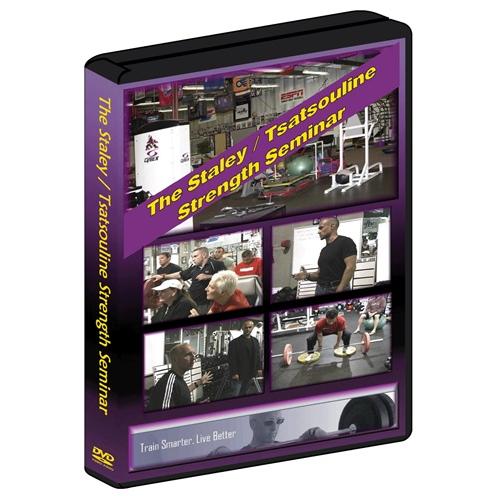
REVIEW: Staley/Pavel Strength seminar

This is a seminar from 2006, but I only got the chance to see it recently. It's a pretty expensive buy from the US, but a friend found a cheap copy in Oz & so I finally had a chance to see this 2 DVD set.

If you've got any interest in training & are vegan or veggie you may not like Charles Staley's nutritional view. When he was with Iron radio he was a member of PETA (Please Eat The Animals, not the other one) & some of his more controversial out bursts may have tainted your view on him. That being said, I'd suggest you open your mind his training views.  His 'big idea' EDT (escalating density training) is a very useful way to train many clients (or yourself) if you are looking for physique changes. The basic premise is pretty simple, so as an example lets take a kettlebell snatch (as that was used in the seminar), you do sets of 5 for fifteen minutes, once you can no longer do sets of 5, drop to sets of 4, then set of 3 when you can no longer do 4, down to sets of 1 rep if you have to. You rest as much as you need between sets, but stop at 15 minutes. The idea is to do more reps each time you repeat that 15 minute workout over the weeks. Obviously there's a lot more to it than that, but that is the framework. You must keep the form tight, but that's really it, doing more in a set time frame. He also teaches Olympic lifting (I will be reviewing another Staley seminar, this time on Olympic lifting quite soon). Staley is a clear speaker & has quite a few training ideas you might find useful...I just wouldn't ask him any nutritional advice or he might annoy you a bit!

Pavel Tsatsouline (generally just called Pavel) is someone who knows movement. He's best known for kettlebells, but he's worked with powerlifters, sports people, fighters etc., basically everyone out there. He does have 'his style' which is stories about Russia & thankfully doesn't use the whole 'comrade' term as much as he used to (I find it a little off-putting). He has some very insightful thoughts on training & fixing training issues (I wish I was as fast, for me I often have to sit down & think about things before an answer comes to me). Some of the ideas like "Same but different", that is instead of doing a whole pile of different exercises find a few & try variation. So, using deadlift as an example, you could do conventional deadlift, sumo, rack pulls, standing on blocks, using bands or chains, using a trap bar, using a Jefferson lift or hack deadlift (I didn't even think of the last 2 myself & I've thought about deadlift a little!) can improve your lift, as they work the same motor pathways, but are different, so SAME motor patheways, DIFFERENT exact movement, so you will continue to improve, without risking overuse & not risk boredom either, the important point is not to pick just any movement, but one that works a weak point in your lift. Even hand position (for example a snatch grip), or foot position (sumo, conventional, close stance) also can be used just to make things a little different & so you can reap rewards.

There was a lot in this seminar. I will be watching it again I suspect as it was an information dense product. I enjoyed it quite a lot & learnt quite a few things I can put into practice in the near future.

You can get hold of the seminar at Dragon door (or you can do like mate & search about for a cheaper copy as they are out there).